
Adam’s Chronicle
The Fold-Out Bible & World History Timeline
- For Homeschool, Church & Family
- Connect People, Places & Time Periods
- See Bible & World History Side by Side
2 × Classic Edition
Purchased today, shipped tomorrow
30-DAY MONEY-BACK GUARANTEE
Not the right fit? Send it back within 30 days for a refund.
Inside Adam’s Chronicle
History makes more sense when you can see the connections.
You may know the names, the stories and the dates. The harder part is picturing how they fit together.
Adam’s Chronicle opens into a connected panorama of Bible and world history. Follow a familiar person or period across the chart, then look alongside it to explore the rulers, cultures and events sharing that stretch of time.
Open a period. Discover the world around it.
The accordion-fold panels keep neighboring timelines in view. Open a few for a closer look, spread out a longer section for a shared lesson, then fold the chart back between its covers.
- For Bible study: explore biblical chronology alongside the civilizations and empires shown in the chart.
- For family learning: give everyone a place to point, compare and ask the next question.
- For your own curiosity: follow a name that interests you and see where the surrounding details lead.
A historic chart, made to unfold.
This is a reproduction of Sebastian C. Adams’s nineteenth-century historical chart—not a newly written history textbook. Its biblical chronology and interpretations reflect its original author and period. Explore it alongside modern historical sources.
Choose your edition.
Choose Classic Edition or the gold-finish hardcover Collector’s Edition. Mix editions in a two- or three-book set to keep one and share the others.
The display stand, magnifier, Bible and gift wrapping shown in styled images are not included with the chart.
Featured reviews

A must-have for church teachers who want to show where and when biblical events happened.

An incredible tool for helping my kids see history instead of simply memorizing names and dates.

I thought it was just a timeline, but it’s so much more - a great addition to any library!
Good to know
Is it a regular book or a fold-out chart?
It is an accordion-fold chart between covers. Open a few connected panels to explore a period, or unfold a wider stretch to compare neighboring timelines.
Does it include Biblical history?
Yes. Biblical genealogy and chronology appear alongside world history. The chart reflects its historical author’s perspective; read its dates and interpretations alongside modern sources.
Shipping & delivery
Free U.S. shipping on orders of $60 or more. Orders ship within 24-48 hours and typically arrive 7–10 business days after dispatch.
Not happy? You have 30 days to return them for a full refund, no questions asked.
Your browser paused playback. Tap a video to play.
01 / OPEN THE STORY
A book on the shelf. A panorama on the table.
Keep neighboring histories in view as the connected panels unfold. Explore a few at a time, then fold it neatly away when you’re finished.

Explore the whole chart
Choose a landmark, then read down the chart to see which lives and kingdoms Adams placed alongside it.
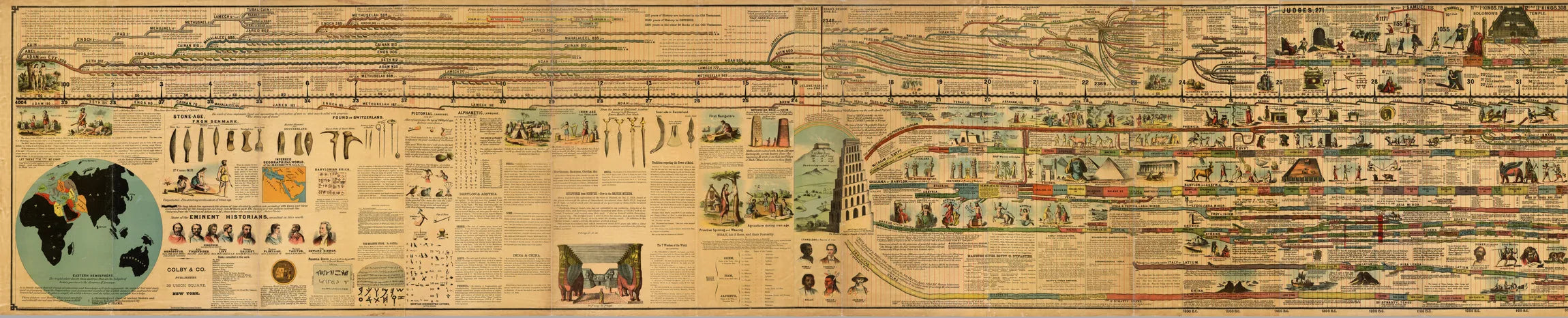
Reading the chart
Start at Creation
Follow a family line across the page. Then look below it to see where another story begins.
Jump to a landmark
Pick a Bible moment
Choose a Bible passage and explore the wider world of the period shown on the chart.
In the Bible · Exodus 12–14
Moses leads Israel out of Egypt
1491 BC on the chart
Exodus tells how the Israelites leave Egypt after the first Passover. Adams places their departure in 1491 BC. Its historical date remains uncertain.
Around the world
- Egypt
- New Kingdom pharaohs rule along the Nile.
- Greece
- Mycenaean communities flourish on the Greek mainland.
- China
- Shang artisans cast elaborate bronze vessels.
In the Bible · 1 Kings 6
Solomon builds the Temple
About 1000 BC on the chart
First Kings says construction began in Solomon’s fourth year. Beside the Temple, Adams marks the foundations in 1012 BC and the dedication in 1004 BC.
Around the world
- Egypt
- Power is divided between northern rulers and leaders at Thebes.
- Greece
- Athenian potters decorate vessels with rings of concentric circles.
- China
- The Western Zhou kings rule from the Wei River valley.
In the Bible · Daniel 1
Daniel enters the Babylonian court
About 600 BC · setting of Daniel 1
The book of Daniel opens with young exiles from Judah learning the language and literature of Babylon.
Around the world
- Rome
- In Roman tradition, the city is still ruled by kings.
- Greece
- Around 594 BC, Solon reforms the laws of Athens.
- China
- Regional states compete during the Spring and Autumn period.
In the Bible · Luke 2 and Matthew 2
The Nativity in Bethlehem
The turn of the era
Luke tells of shepherds visiting the newborn Jesus in Bethlehem during Augustus’s reign. Matthew tells of the Magi who later come to honor the child.
Around the world
- Rome
- Augustus is the first Roman emperor.
- Egypt
- Egypt has become a Roman province after Cleopatra’s death.
- China
- Western Han emperors govern from Chang’an.
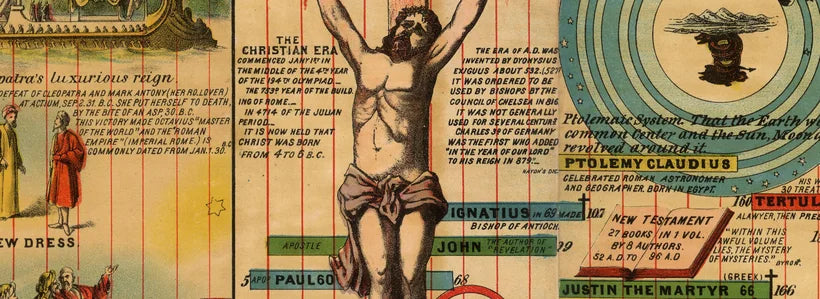
In the Bible · Luke 23 and John 19
Jesus is crucified outside Jerusalem
Early first century AD
Luke recounts Jesus’s trial before Pontius Pilate. John names the place of crucifixion as Golgotha, near the city.
Around the world
- Rome
- Tiberius reigns as emperor.
- Britain
- Claudius launches the invasion of Britain in AD 43.
- China
- Emperor Guangwu has restored Han rule.
Adams used Archbishop James Ussher’s biblical chronology. Dates marked “on the chart” follow that tradition. The world-history notes describe the wider period.
Choose your bookEvery era, side by side
Follow each column on its own. Gold highlights connections to explore across the chart.
Bible history
Creation to the early church
- Creation
- Adam and Eve
- Adam and Methuselah overlap in the chart’s genealogy
- Noah and the Flood
- Babel and the dispersion of peoples
- Shem lives into Abraham’s lifetime in the chart’s genealogy
- Abraham, Isaac and Jacob
- Joseph at Pharaoh’s court
- Moses leads Israel out of Egypt
- Joshua and the judges
- Samuel anoints Saul
- David faces Goliath
- Solomon’s Temple at Jerusalem
- The kingdom divides into Israel and Judah
- Elijah and the prophets
- Assyria takes the northern kingdom
- Daniel’s story is set in Babylon during Rome’s traditional age of kings
- The return from exile under Persia
- Esther at the Persian court
- The centuries between the Testaments
- Herod the Great rules Judea while Cleopatra VII rules Egypt
- The Nativity at Bethlehem
- The Crucifixion and Resurrection
- The apostles and the early church
World history
Ancient Egypt to the nineteenth century
- Pharaonic Egypt
- The Assyrian kingdoms
- Babylon on the Euphrates
- The Persian Empire
- The Greek city-states
- The conquests of Alexander
- Rome under kings, consuls and emperors
- The Colosseum opens in Rome in AD 80
- The dynasties of China
- The end of the Western Roman Empire
- Medieval kingdoms
- The empire of Charlemagne
- The Crusades
- European printing with movable type
- Columbus’s Atlantic voyages
- The Reformation
- American independence
- United States presidents in the 1800s
A CHART YOU CAN KEEP COMING BACK TO
For the lesson. For your own curiosity.
 FOR FAMILY LEARNING
Give a lesson a bigger picture.
Open it beside a history lesson or Bible story. Keep the person you are discussing in view while exploring the lives, places and events around them.
WHY YOU’LL REACH FOR ITA shared place to point, compare and ask the next question.
 FOR YOUR OWN CURIOSITY
Put your favorite period in context.
Bring it out alongside a history book or documentary. Compare rulers, cultures and timelines in one connected view, then follow the details that catch your attention.
WHY YOU’LL REACH FOR ITKeep the wider picture open while you explore the details.
The difference
One chart vs. the rest.

| Product benefits | Adam’s Chronicle | Page-by-page books |
|---|---|---|
| Connected fold-out panels | ✓ | × |
| Neighboring timelines visible together | ✓ | × |
| Bible and world history side by side | ✓ | Varies |
| Historical chart reproduced in detail | ✓ | Varies |
| Fold-out format | ✓ | Varies |
GOOD TO KNOW
A few things before you unfold it.
Format, perspective and practical details.
Is it a regular book or a fold-out chart?
It is a printed accordion-fold chart held between covers. Its connected panels let you open a stretch of the timeline and compare neighboring material, then fold it back into book form.
Does it include Biblical history?
Yes. Biblical genealogy and chronology are part of the chart alongside historical timelines. It reflects the historical author’s Biblical perspective rather than a modern consensus chronology.
Is it for homeschooling or adult readers?
Both can explore it. Families can use familiar people and events as starting points for discussion; adult readers can follow the detailed timelines independently. Dense print and historical language make younger readers likely to benefit from adult guidance.
Is this scripturally and historically accurate?
The chart follows Archbishop James Ussher’s traditional biblical chronology, connecting biblical events with major moments in world history. It’s designed as a faith-based educational resource for Christian families, churches, and educators.
How is this different from other Bible timelines?
Most timelines show one event at a time, page by page. This chart lays out thousands of years across a single, continuous panorama — so you see what was happening in different nations and cultures at the exact same moment, side by side. It’s a fundamentally different way to understand history: all at once, instead of piece by piece.
Will my family actually use this, or will it just sit around?
This is designed to be revisited again and again — not a one-time read. Families use it for ongoing Bible study, homeschool history lessons, or simply as something to explore together on a Sunday afternoon. It’s built to become part of your regular routine, not a shelf decoration.